

The Neck Care Routine Nobody Taught You: A Guide for Women Over 40
At some point in your thirties or forties, you probably noticed that your neck was starting to tell a different story than your face. Not dramatically, at first. Just a shift. A softening of the jawline. Skin that looked a little looser than it used to. A texture you did not recognize in photos.
What most women do not know is that this was years in the making, and that almost nobody does anything about their neck until they can already see the problem. That is not a criticism. It is a gap in what we were ever taught about skincare. Face routines get all the attention. Neck care gets almost none, despite the fact that the neck is one of the first places visible aging shows up and one of the hardest to reverse once it does.
This guide is the routine nobody handed you. It covers what the neck actually needs, why it ages differently than your face, what products and ingredients to use, and where a lifting support fits into a daily routine that works. If you want to understand the biology behind why your neck is changing, this article on why the neck ages faster than the face covers the science in full. If you are here for the practical routine, keep reading.
Why Your Neck Has Different Needs Than Your Face
The neck is not just the face with a longer commute. It has meaningfully different skin characteristics that require a different approach.
Neck skin is thinner than facial skin, with fewer oil glands and less natural moisture retention. It moves constantly, flexing through a wide range of motion dozens of times an hour. It is almost never protected by makeup or SPF the way the face typically is. And it has fewer sebaceous glands, which means it dries out faster and has less built-in protection against environmental damage.
These differences mean two things for your routine. First, ingredients that work on your face may be too aggressive for your neck. Dermatologists consistently flag retinol and exfoliating acids as common sources of neck irritation when transferred from face routines without adjustment. Second, the neck actually needs more deliberate care than the face, not less, because it has fewer of the natural defenses that the face benefits from.
The hormonal dimension matters too. As estrogen declines during perimenopause, collagen production loses a key driver. Research has found that estrogen deficiency is directly linked to loss of collagen, elastin, and fibroblast function in skin tissue. This is part of why so many women notice their neck changing in their forties in a way that feels faster than they expected. The collagen breakdown that accelerates after 30 is real, and the neck feels it sooner than almost anywhere else.
The Morning Routine
Step 1: Gentle Cleanser (or Skip It)
Unless you applied neck products overnight, the neck does not need to be washed with cleanser in the morning. Warm water is sufficient. If you are using an oil-based or balm cleanser on your face, you can extend it to the neck and chest, but a dedicated morning cleanse is not necessary for most skin types and can strip the limited moisture the neck retains naturally.
Step 2: Vitamin C Serum
Vitamin C is one of the most evidence-supported ingredients for collagen stimulation and antioxidant protection. Extending your face vitamin C serum down to the neck and upper chest is one of the simplest upgrades you can make to an existing routine. Apply it to the neck in upward strokes, from collarbone to jaw. Let it absorb before moving to the next step.
If your current vitamin C is a high-percentage L-ascorbic acid formula and causes any sensitivity on the neck, switch to a gentler derivative like ascorbyl glucoside or sodium ascorbyl phosphate for the neck application specifically.
Step 3: Peptide-Rich Moisturizer
Peptides are the ingredient category that earns the most consistent dermatologist endorsement for neck care. They signal the skin to produce collagen without the irritation risk that comes with retinoids, and they work well on the thinner, more reactive skin of the neck. Look for a formulation that includes ingredients like palmitoyl pentapeptide, copper peptides, or matrixyl. Apply from collarbone to jawline in upward strokes.
Avoid anything with heavy fragrance or essential oils in the formula. Neck skin is reactive, and fragrance is one of the most common sources of contact irritation in this area.
Step 4: SPF on the Neck
This is the single most skipped step in neck care, and it has an outsized impact on long-term outcomes. UV damage is the primary accelerant of collagen degradation in skin, and the neck is exposed to sun most of the day while being almost universally unprotected. Extending your facial SPF to the neck and upper chest takes ten additional seconds and meaningfully changes the trajectory of how that skin ages.
Use at least SPF 30, reapply if you are outdoors for extended periods, and choose a formula that does not transfer to clothing. Mineral formulas with zinc oxide tend to sit more comfortably on the neck without the white cast that concerns some women, though many modern chemical filters are equally effective and easier to wear under clothing.
Step 5: Lifting Support
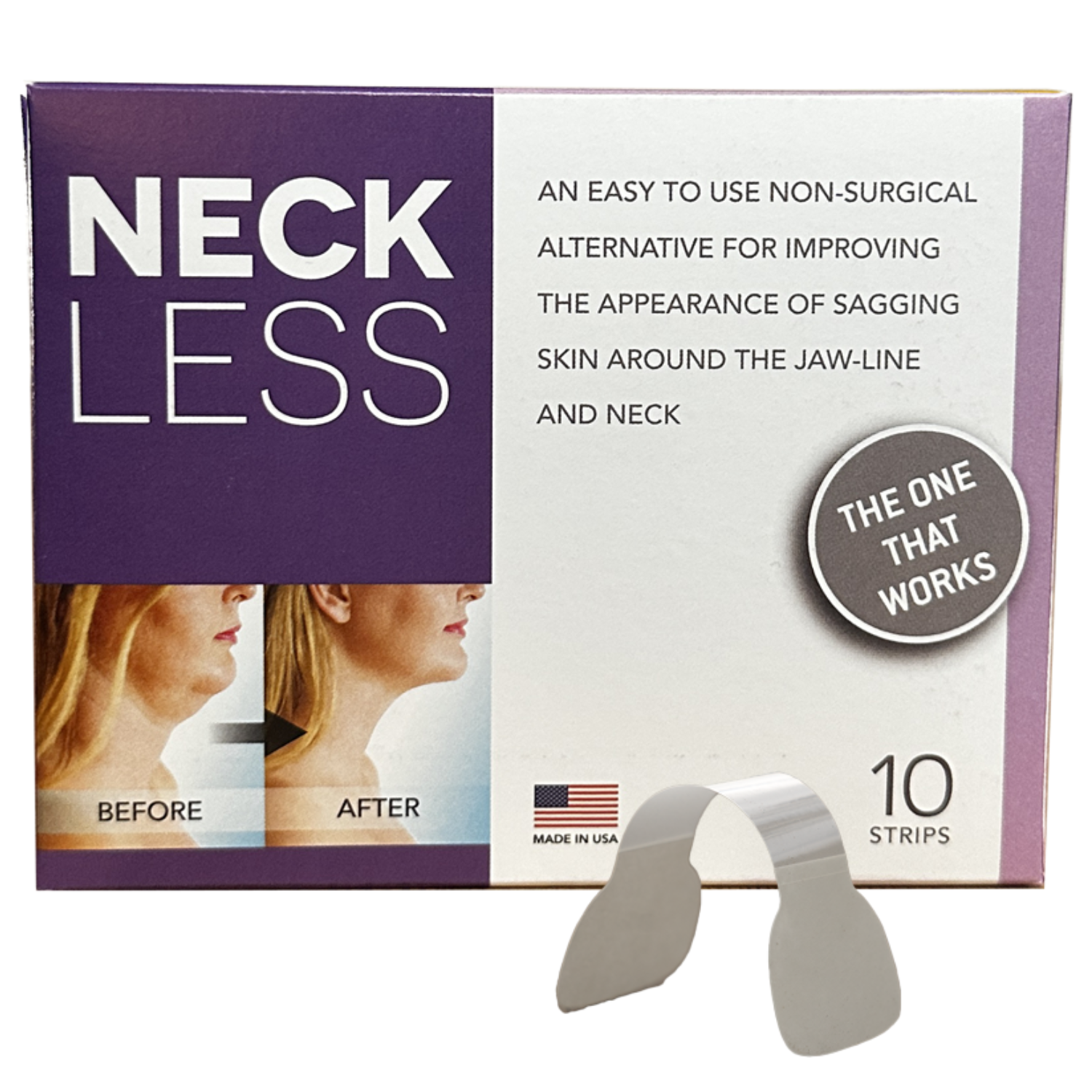
For days when appearance matters, applying a lifting strip as the last step before dressing gives you a physical result that no skincare product can replicate. Where topicals work gradually over weeks and months to improve skin quality, a medical-grade lifting strip produces an immediate visible improvement by repositioning the tissue under the chin and along the jawline. The two approaches are complementary, not competing.
Neck Less lifting strips are applied to clean, dry skin after skincare has absorbed fully. The strip creates a directional lift that holds through a full day of wear, is invisible under clothing, and works in any lighting. For a step-by-step application walkthrough, the Neck Less application guide covers placement, skin prep, and technique. The 10-strip pack is the right starting point if you are new to the product.
The Evening Routine
Step 1: Thorough Cleanse
The evening cleanse is where you remove adhesive residue from a lifting strip, sunscreen, and any environmental buildup from the day. A gentle micellar water or an oil-based cleanser works well for this. If you used a lifting strip that day, use a soft cotton round with micellar water to lift the adhesive residue before your main cleanse. Do not pull or tug at the skin during removal.
Step 2: Retinoid (with Caution)
Retinoids are the most clinically proven ingredient for stimulating collagen production and improving skin texture over time. They also carry the highest irritation risk on neck skin, which is thinner and more reactive than the face. If you want to include a retinoid in your neck routine, start with the lowest available concentration, apply it every third night to start, and never apply it on the same night as an exfoliating acid or active vitamin C. If irritation develops, reduce frequency further before giving up on it entirely. Many women find that retinal, a gentler retinoid derivative, works well on the neck at a cadence that retinol cannot.
If retinoids are not working for your neck skin, peptides used consistently in the evening are a legitimate alternative with a lower irritation profile and real evidence for collagen support.
Step 3: Rich Neck Moisturizer or Overnight Treatment
Evening is the time to use your richest neck formulation. Ceramide-heavy moisturizers support the skin barrier overnight and help retain the moisture that neck skin loses quickly due to its lower oil gland density. Apply in upward strokes, from collarbone to jaw, and include the jawline and lower face if your day formula did not cover it.
Sleeping on your back, or on a silk pillowcase if you are a side sleeper, reduces the mechanical compression that accelerates neck line formation overnight. It is a small adjustment with a meaningful impact over years of cumulative sleep positions.
Weekly Add-Ons Worth Considering
Gentle exfoliation once a week. A low-percentage lactic acid (around 5%) applied to the neck once weekly helps with texture and absorption of the ingredients you use daily. Avoid more aggressive exfoliants on the neck. The neck does not need the same exfoliation intensity as the face and will respond with irritation if pushed.
Gua sha or lymphatic massage. Gentle upward massage along the neck and jawline improves circulation and temporarily reduces puffiness in the submental area. It does not produce structural change in the skin, but as a complement to a consistent product routine it supports overall skin health in the area. Use a facial oil as a slip layer and keep the pressure light.
The Honest Ceiling of Topicals
A good neck skincare routine matters. It slows the progression of visible aging, improves skin quality over time, and is one of the most cost-effective investments you can make in how your neck looks at 60 compared to 40. But it is also honest to say that topicals have a ceiling.
No serum or moisturizer will reverse established laxity. If the skin has already lost significant structural support, products maintain what is there but cannot rebuild what has redistributed. For women whose primary concern is visible laxity rather than texture and dryness, combining a topical routine with a physical support solution addresses both the present and the future simultaneously.
Understanding where the non-surgical options sit relative to each other, including what energy-based treatments, injectables, and lifting strips can and cannot do, is useful context for deciding how to approach this. This comparison of non-surgical neck tightening options covers the full range honestly.
And if you have ever wondered whether surgery might be the right answer for your situation, the realistic cost picture is worth understanding before making any decisions. This breakdown of neck lift surgery cost versus non-surgical alternatives gives you the numbers straight.
A Simple Routine to Start With
If you are starting from zero, here is the minimum viable neck care routine that covers the most important bases without adding significant time or cost to what you are already doing:
Morning: Extend your vitamin C serum and facial SPF to the neck and upper chest. That is it to start. You are already applying both to your face. Including the neck takes ten additional seconds.
Evening: Extend your facial moisturizer to the neck in upward strokes. If your moisturizer contains peptides or ceramides, even better.
Once those habits are automatic, layer in a dedicated neck moisturizer in the evening, then a retinoid at low frequency, then weekly exfoliation. Build gradually rather than trying to implement everything at once. Consistency over weeks and months is what produces results in skincare. The routine that you actually do every night is better than the optimized routine that sits on your bathroom shelf unused.
For women who want results they can see today while building toward better skin long-term, adding a lifting strip on days that matter gives you both timelines at once. Women who use Neck Less regularly describe it as the piece of their routine that made everything else feel like it was working. The topicals do their quiet work over months. The strip shows you the result in the morning.
The Bottom Line
The neck care routine nobody taught you is not complicated. It is mostly the face routine you already have, extended downward with a few adjustments for the different needs of neck skin. Vitamin C and SPF in the morning. A peptide-rich moisturizer twice daily. A retinoid at low frequency in the evening if your skin tolerates it. SPF on the neck every single day without exception.
Start now, whatever age you are. The women who see the most dramatic difference between their face and their neck at 60 are almost always the ones who treated those two areas differently for decades. The ones who extended their face routine downward consistently are the ones who look in the mirror at 60 and cannot tell where the face ends and the neck begins.
That outcome is available. It just requires making the neck part of the conversation before the problem is already visible.
Ready to add physical support to your neck care routine? Shop Neck Less lifting strips in 10, 25, 50, or 100-pack options. Patented. Made in the USA. 30-day money-back guarantee.
Hope Granger is a beauty and wellness writer who has spent over a decade covering non-surgical skincare, aging gracefully, and women's confidence. She writes for women who are done being sold false promises and just want honest answers.