

Neck Lift Surgery Cost in 2026: Is It Worth It? Plus Affordable Alternatives
If you have spent any time researching turkey neck solutions, you have probably landed on neck lift surgery at some point. It is the option that promises the most dramatic, longest-lasting result. It is also the one with the longest price tag, the longest recovery, and the longest list of things that can go sideways.
This article is not going to talk you out of surgery or talk you into it. What it will do is give you the honest numbers, the full cost picture most pricing articles leave out, and a clear-eyed look at what the alternatives actually deliver, so you can make a decision based on real information rather than sticker shock or wishful thinking.
What Does a Neck Lift Actually Cost in 2026?
The number you will see quoted most often is the surgeon's fee, which according to the American Society of Plastic Surgeons averages around $7,885. That number is real, but it is also incomplete. It is roughly half to two-thirds of what you will actually pay.
Here is what the full cost actually looks like when you add everything in:
- Surgeon's fee: $5,000 to $12,000 depending on experience, technique, and location
- Anesthesia: $1,000 to $2,500
- Surgical facility fee: $1,000 to $3,000
- Pre-operative labs and medical clearance: $100 to $500
- Post-op supplies (compression garments, scar treatments, prescriptions): $100 to $400
Add it up and most neck lifts fall between $10,000 and $15,000 out of pocket. Complex cases or procedures performed by top surgeons in New York, Los Angeles, or Miami can push well past $20,000. A mini neck lift, which addresses less severe laxity with a smaller incision and shorter recovery, typically runs $3,500 to $10,000 all-in.
Geography is one of the biggest variables. The same procedure from a comparably qualified surgeon can cost significantly more in a major coastal city than in the Midwest or Southeast. That does not necessarily mean traveling for surgery is a good idea, but it does mean the price range is genuinely wide depending on where you live.
What Insurance Will and Won't Cover
Almost nothing. Neck lift surgery is classified as a cosmetic procedure, which means most health insurance plans and Medicare will not cover it. The exception is rare: if excess skin is causing a documented medical problem, such as chronic rashes or skin infections from skin-on-skin contact, a portion of the surgery might qualify for coverage. Your surgeon would need to document medical necessity, and even then the cosmetic component of the procedure comes out of your pocket.
HSA and FSA funds typically cannot be used for cosmetic procedures either, unless there is a qualifying medical component. Do not plan your budget around reimbursement unless your surgeon explicitly confirms coverage in advance.
Most plastic surgery practices offer financing through services like CareCredit or Alphaeon, which offer promotional zero-interest periods if you pay the balance within 12 to 24 months. Some practices offer in-house payment plans as well. These options are worth exploring, but interest charges on a $12,000 balance add up quickly if you carry the balance past the promotional window.
The Recovery Cost Nobody Mentions
The financial cost of a neck lift does not end when you leave the surgical center. Recovery has its own price, and not just in dollars.
Most patients take one to two weeks off work after the procedure. Bruising and swelling are visible for the first 10 to 14 days, and strenuous activity is off limits for four to six weeks. If you have a physically demanding job, work in a client-facing role, or do not have paid leave available, that downtime has a real cost that is separate from the surgical bill.
You will also need someone to drive you home from surgery and stay with you for at least the first night. Childcare, pet care, or other caregiving responsibilities that your normal routine covers will need backup during recovery. These logistical costs are easy to underestimate when you are focused on the procedure itself.
Is It Worth It?
That depends almost entirely on the severity of your laxity and your goals.
For women with significant skin laxity, visible muscle banding, and a strong jawline definition concern that has not responded to non-surgical approaches, neck lift surgery produces results that nothing else can match. Satisfaction rates among patients treated by board-certified surgeons are high, and results typically last 10 to 15 years with proper skincare and sun protection. For that patient, the investment can be genuinely worth it.
For women in the earlier or middle stages of neck laxity, the math looks different. Surgery for mild or moderate laxity produces a result that may not justify the cost, the downtime, or the surgical risk compared to what non-surgical options can deliver. And the non-surgical landscape in 2026 is meaningfully better than it was five years ago.
The honest answer is that surgery is the right answer for some women and the wrong answer for many others, and the difference has less to do with age than it does with the actual degree of laxity and what you are realistically trying to achieve.
What the Alternatives Actually Cost
Before deciding whether surgery is worth $10,000 to $15,000, it is worth knowing what the alternatives cost and what they can realistically deliver.
Energy-Based Treatments
Ultherapy, radiofrequency treatments, and similar energy-based devices use focused energy to stimulate collagen production in deeper layers of skin. Results are real but gradual, typically taking three to six months to fully appear, and most providers recommend repeat treatments annually to maintain them. A single Ultherapy treatment for the neck runs $1,500 to $4,000. Over several years of maintenance, the cumulative cost approaches surgical territory without the permanence.
These treatments work best for women with mild to moderate laxity. They are not a substitute for surgery on advanced cases.
Injectables
Botox injected into the platysmal bands, the vertical cords that become visible in the neck with age, can soften their appearance. This is sometimes called the Nefertiti lift. It does not address skin laxity directly but can improve the overall look of the neck when banding is a primary concern. Cost runs $300 to $600 per treatment, with results lasting three to four months. Annual maintenance cost is approximately $1,200 to $2,400.
Kybella, an injectable that dissolves submental fat, addresses a double chin specifically rather than skin laxity. It works for the right candidate but is not a turkey neck solution on its own.
Topical Skincare
Retinoids, peptides, and vitamin C can support collagen production and improve skin texture over time. The evidence for topical ingredients at this level of concern is real but limited. They are most effective as a preventive and maintenance strategy rather than a treatment for visible laxity. Cost ranges from affordable to significant depending on the products you choose, but no topical routine will produce a result comparable to physical lifting on established laxity. For a full breakdown of where topicals fit in the picture, this article on collagen and neck aging covers the science clearly.
Medical-Grade Lifting Strips
This is the category that gets overlooked in most cost comparisons because it is relatively new as a serious option. Medical-grade lifting strips are not fashion tape or standard adhesives. They are engineered specifically to lift and reposition submental tissue, producing a physical improvement in the appearance of the neck and jawline that holds throughout the day.
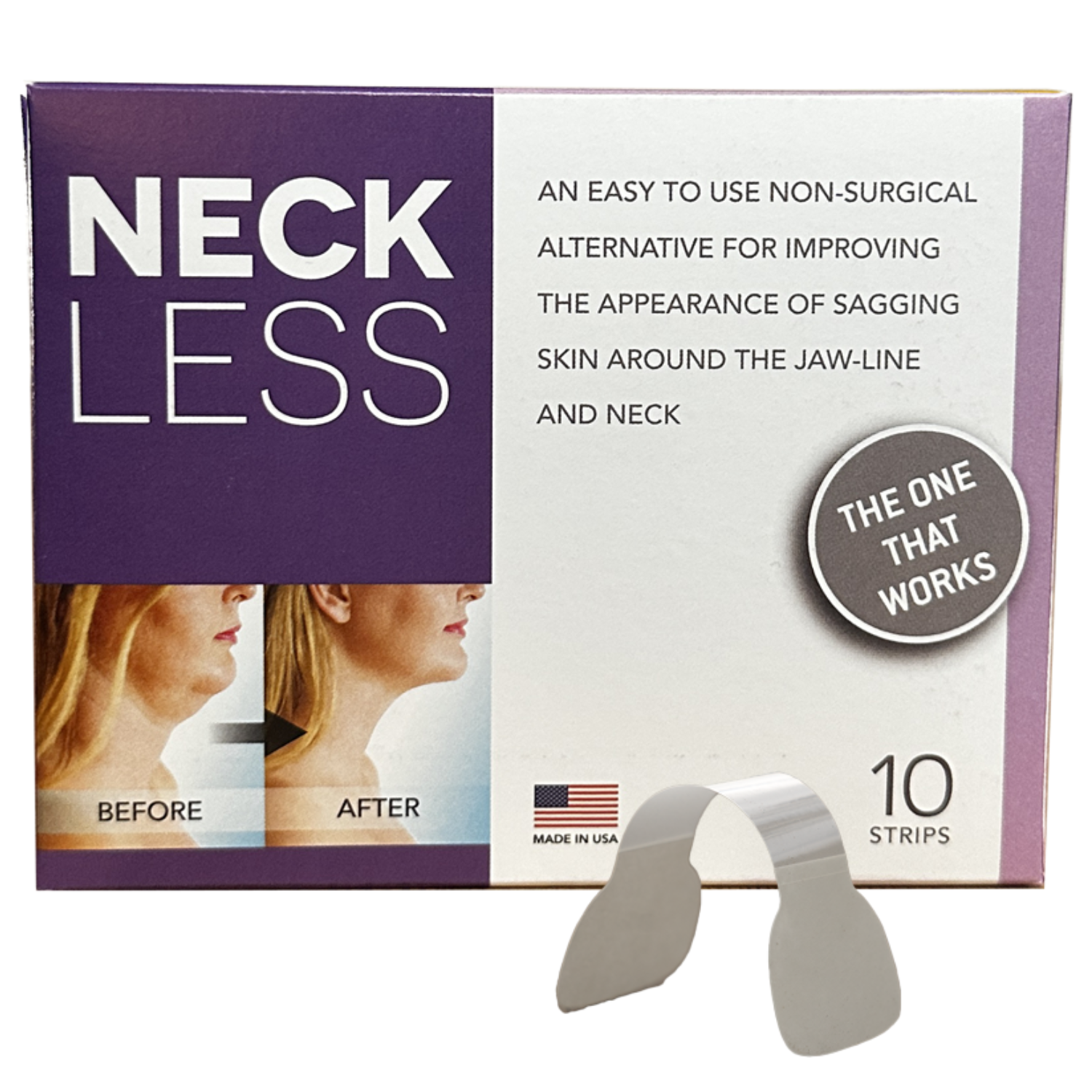
Neck Less lifting strips were developed by an aesthetician specifically for neck and jawline support, and they are patented and made in the USA. The result is immediate rather than gradual, visible in any lighting, and requires no recovery time, no consultation, and no surgical risk. A 10-strip pack lets you test the results before committing to a larger supply, and the No Trace Bundle is designed for women with shorter hair where concealment requires a slightly different approach.
The cost per use is a fraction of any clinical treatment. For women who are not ready for surgery, managing laxity with daily support while monitoring whether their concern warrants a clinical investment is a genuinely practical approach. Women who use Neck Less regularly describe it as the option that gave them back their confidence in photos and at events without committing to a surgical timeline.
For a broader comparison of non-surgical options and where each one fits, this breakdown of at-home neck tightening options covers the full landscape with honest assessments of each category.
A Practical Framework for Deciding
Here is a simple way to think through the decision:
If your laxity is mild to moderate and your primary concern is how you look in photos and everyday situations, non-surgical options including lifting strips, energy-based treatments, and injectable maintenance can deliver a meaningful result at a fraction of the surgical cost and without any of the downtime or risk. Surgery at this stage is likely to be more than the situation requires.
If your laxity is moderate to significant and non-surgical options have not produced the result you are looking for, a consultation with a board-certified facial plastic surgeon is a reasonable next step. Get at least two consultations before committing, ask to see before and after photos of patients with similar concerns, and ask specifically about recovery expectations and complication rates.
If you are not sure where your laxity falls on that spectrum, start with non-surgical options. The experience of using them, and noting whether the result satisfies you or falls short, is genuinely useful information for deciding whether surgery makes sense for your situation.
The Bottom Line
Neck lift surgery in 2026 costs between $10,000 and $15,000 for most patients when you account for the full bill, not just the surgeon's fee. It is not covered by insurance. It requires one to two weeks of recovery and four to six weeks of activity restrictions. For the right candidate with significant laxity, it produces results nothing else can match and those results last. For the large majority of women with mild to moderate concerns, the non-surgical options available today can deliver a satisfying result at a cost that is orders of magnitude lower, without putting a single day of normal life on hold.
The decision is personal. The numbers, at least, should be clear before you make it.
Want to see what a physical lifting solution looks like without a surgical consultation? Shop Neck Less lifting strips in 10, 25, 50, or 100-pack options. Patented. Made in the USA. 30-day money-back guarantee.
Hope Granger is a beauty and wellness writer who has spent over a decade covering non-surgical skincare, aging gracefully, and women's confidence. She writes for women who are done being sold false promises and just want honest answers.