

Why Your Neck Ages Faster Than Your Face (And What to Do About It)
At some point, usually somewhere in your 40s, sometimes earlier, you notice that your face and your neck seem to be aging on completely different schedules. Your face still looks pretty much like you. Your neck looks like it got a head start.
This is not your imagination. There's a real biological reason for it, and it has nothing to do with how well you've taken care of yourself. The neck was simply never built the same way as the face. And once you understand the structural differences, the whole thing starts to make a lot more sense.
The Neck Was Always Working With Less
The skin is thinner
The skin on your neck is naturally thinner and more delicate than the skin on your face. Thinner skin has less structural depth, less of a buffer against physical stress, and less ability to retain what keeps it looking full and smooth. Think of it as the difference between a fabric with more thread count versus less — both cover you, but one holds its shape a lot longer.
Fewer oil glands mean less natural moisture
Your face has a dense network of sebaceous glands that produce oil and help maintain the skin's moisture barrier. Your neck has significantly fewer. That means it dries out faster, loses hydration more quickly, and has less built-in protection against the environmental factors that degrade skin over time. Dryness accelerates everything — the crepey texture, the fine lines, the general loss of that smooth, taut appearance.
It gets more sun than most of us realize
Think about how often you apply sunscreen to your neck. Really think about it. Most women protect their faces rigorously and stop right at the jawline, leaving the neck exposed year after year. But the neck gets UV exposure almost constantly — any time you're outside, driving, sitting near a window. Decades of unprotected sun exposure break down collagen steadily and quietly. By the time you notice the visible effects, the damage has been accumulating for a long time.
A landmark study in the Journal of Investigative Dermatology found that UV exposure accounts for approximately 80% of visible facial and neck aging. Not genetics, not time — sun. And the neck is almost always the least protected part of the equation.
Your skincare routine stops at the jawline
This one is worth saying out loud, because almost nobody talks about it. The serums, the retinoids, the vitamin C, the collagen-supporting peptides — most routines apply all of it to the face and treat the jawline as the finish line. The neck gets nothing. No protection, no support, no active ingredients. Meanwhile it's dealing with all the same aging forces as the face, without any of the backup.
It's not negligence. It's just something most of us were never taught to think about.
What's Happening Underneath the Skin
The collagen story follows the same arc here as it does everywhere else in the body — starting around your late 20s, production declines by roughly 1% per year. Compound that over two decades and you get a meaningful structural change. Collagen is the scaffolding that keeps skin firm and supported. As it decreases, skin loses its ability to hold its shape against gravity. Here's a closer look at the full science behind why neck skin starts to sag.
The neck, starting from a thinner baseline with less structural depth than the face, feels this loss earlier. By the time it becomes visible, the process has been underway for years. That's what makes it feel so sudden when you notice it — it's not sudden at all. It's just the moment the cumulative change crossed a visible threshold.
Elastin works alongside collagen to give skin that snap-back quality. When you press your skin and release it, elastin is what pulls it back into place. As both proteins decline together, skin starts to drape rather than cling, and gravity — which has been pulling on you since day one — starts winning in places it never used to.
Then there's the platysma muscle, a thin sheet of muscle that runs from your chest up to your jawline. When it's taut, it creates the smooth, defined appearance most people associate with a younger-looking neck. Over time it weakens and can begin to separate, creating those visible vertical bands that run down the front of the neck. It's one of the first muscles most people have never thought about — until they're already seeing it in the mirror.
Hormonal changes add another layer, particularly around perimenopause and menopause. The decline in estrogen shifts where the body stores fat, and the submental area — just below the chin — is one of the first places that shows up, according to research published in Menopause: The Journal of the Menopause Society. Weight fluctuations over the years also contribute, as skin stretches and contracts repeatedly without fully recovering each time.
Does Posture Actually Matter? The Tech Neck Question
You've probably heard about tech neck — the idea that looking down at your phone is causing premature aging in the neck. There's some truth here, but the actual picture is more nuanced than most of the headlines suggested.
A 2014 study in Surgical Technology International calculated that tilting your head 60 degrees forward puts roughly 60 pounds of pressure on the cervical spine. That's a real concern for posture and spinal health. For the skin, the primary effect is the acceleration of horizontal necklace lines — those creases that form from the repeated folding of skin in the same direction.
The deeper structural laxity most people mean when they talk about turkey neck is still driven primarily by collagen loss, genetics, and UV damage. Your phone isn't helping. But it's probably not the main reason your neck looks different at 47 than it did at 35.
What You Can Actually Do About It
Now that you understand why it's happening, the what-to-do part gets cleaner. If you want to go deeper on treatment options, here's a full breakdown of the non-surgical approaches that actually work. Otherwise, here's the short version.
Protect it from the sun. This is the single highest-impact change you can make. Three extra seconds every morning, take the SPF past your jawline. You're not going to undo years of UV damage, but you can stop adding to it today.
Extend your routine below the jawline. Whatever retinoids, peptides, or vitamin C you're already using on your face — bring them down. You don't need separate products. You just need to stop treating your chin as the border.
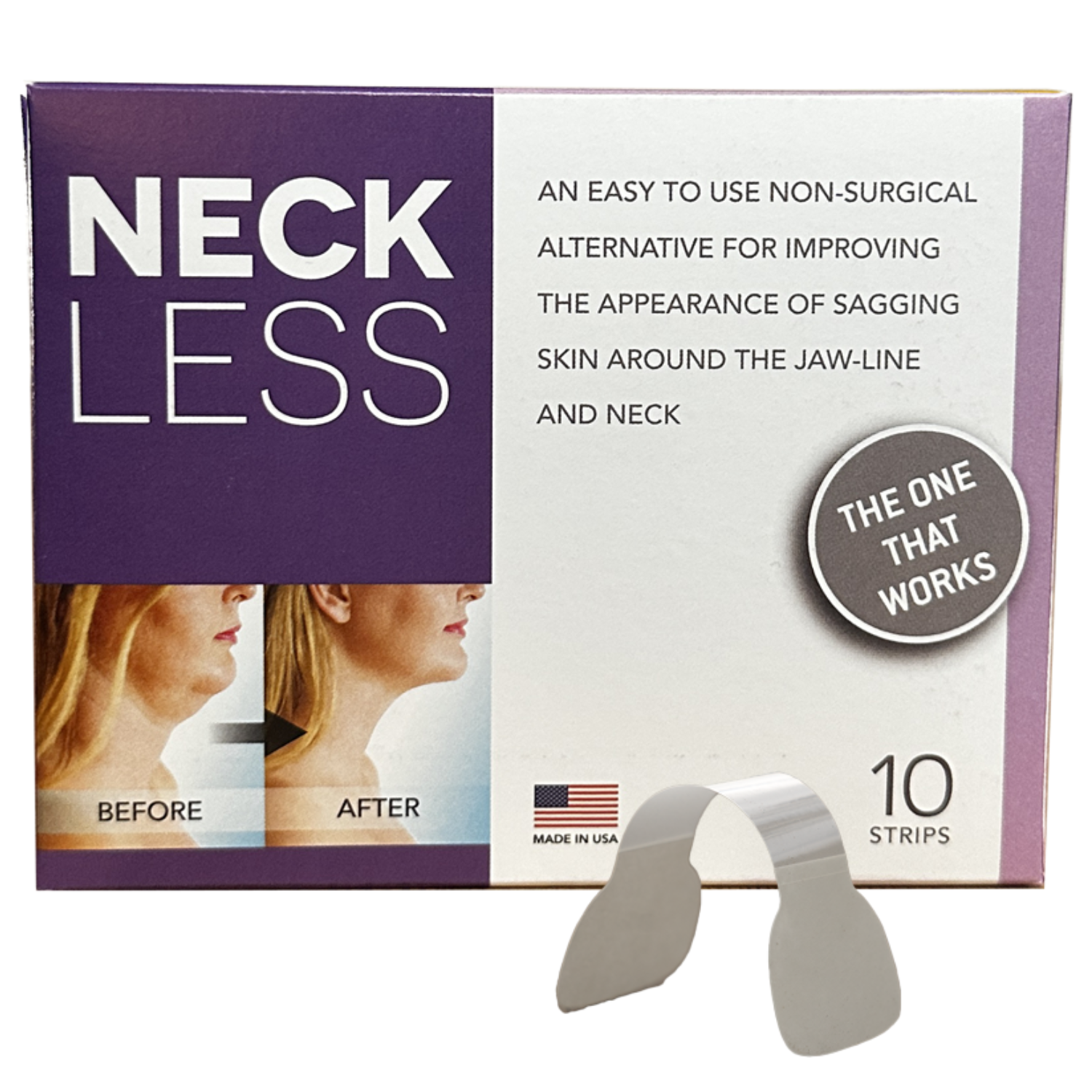
Give your neck daily physical support. This is where Neck Less fits in. While your topical routine works on the long-term picture, Neck Less handles the immediate one. It's a patented, medical-grade strip that physically lifts and smooths the neck area in seconds, with a hold that lasts up to 10 hours. You apply it in the morning as part of your regular routine, and the change in the mirror is immediate. It doesn't replace the longer-term approach. It's the part of the routine that works today, while everything else works on tomorrow. Here's exactly how to use it, and if you want to hear it from other women first, their reviews are worth a read.
Be consistent, not dramatic. The women who see the most meaningful improvement over time aren't doing anything extreme. They're doing a few simple things every day. SPF. Serum. Support. Small habits compounded over months make a bigger difference than any single intervention.
The Bottom Line
Your neck ages faster because it was never built the same way as your face. Thinner skin, fewer oil glands, more unprotected sun exposure, and decades of being skipped by the routines designed to slow exactly this kind of aging.
That's not a personal failing. It's just anatomy — and an oversight that's entirely fixable once you know it's happening. Protect your neck every morning. Nourish it the same way you nourish your face. And give it the daily support it's been missing.
You'd be surprised what consistent, unglamorous habits can do.
Ready to see the difference for yourself? Neck Less gives you a smoother, firmer-looking neck in seconds. Non-surgical. Invisible. 30-day money-back guarantee. Shop Neck Less | See How It Works
Hope Granger is a beauty and wellness writer who has spent over a decade covering non-surgical skincare, aging gracefully, and women's confidence. She writes for women who are done being sold false promises and just want honest answers.