

Best At-Home Neck Tightening Devices in 2026: What Actually Works
At-home neck tightening devices have improved significantly in the last few years. The technology that once required a dermatologist's office and a four-figure treatment bill is now available in a form you can use in your bathroom. The results are not identical to clinical treatments, but for women with mild to moderate laxity who are consistent with their use, the difference is real and measurable.
The challenge is that the device category is crowded, marketing claims are aggressive, and the difference between a device that produces meaningful results and one that does not comes down to specific technology choices and how you use them. This guide covers what actually works, what to look for, and where at-home devices fit in relation to the other non-surgical options available in 2026.
If you are still working out what is causing your neck laxity and want the full picture before investing in devices, the science behind turkey neck covers the biology clearly. If you are ready to evaluate devices specifically, read on.
The Technologies That Actually Tighten Neck Skin
At-home neck devices use three primary technologies. Understanding what each one does, and what it cannot do, is the most important step before buying anything.
Radiofrequency (RF)
Radiofrequency is the most clinically validated technology for non-surgical skin tightening. RF energy heats the deeper dermal layers of the skin without damaging the surface, triggering a collagen remodeling response that gradually firms and tightens the tissue. Clinical studies have shown improvements in skin elasticity of up to 40 percent with consistent RF treatment, and peer-reviewed research supports its effectiveness for mild to moderate skin laxity.
The catch with at-home RF devices is power output. Clinical RF devices operate at higher energy levels than consumer devices, which means results develop more slowly and less dramatically at home than in a dermatologist's office. The practical implication is that an at-home RF device used consistently three to five times per week for eight to twelve weeks produces a visible result, but you should not expect to evaluate it before week eight. Women who try RF devices for two weeks and declare them ineffective are not giving the technology time to work.
For the neck specifically, look for an RF device with a treatment head sized for the larger surface area of the neck rather than a facial device pressed into service. Temperature control and auto-shutoff are important safety features. Avoid the thyroid area at the front center of the lower neck when treating. Do not use RF devices if you have a pacemaker, metal implants in the treatment area, or during pregnancy.
Microcurrent (EMS)
Microcurrent devices send low-level electrical currents through the skin that mimic the body's natural bioelectric signals, stimulating the underlying muscles to tone and lift. Where RF works primarily on skin tissue and collagen, microcurrent works primarily on the muscle layer beneath the skin, which means the two technologies are complementary rather than competing.
The NuFACE Trinity with the ELE attachment is the most recognized consumer microcurrent device and can be used on the neck and jawline area. The Foreo Bear combines microcurrent with sonic pulsations. The JOVS Slimax integrates microcurrent with low-level laser support for a combined approach that addresses both muscle tone and collagen production.
One important note from JOVS's own guidance: some microcurrent devices are not recommended for use directly on the neck due to the concentration of blood vessels and lymphatic structures in the area. Check the manufacturer's instructions specifically for neck use before applying any microcurrent device below the jaw.
LED Light Therapy
Red LED light at wavelengths around 630 to 670 nanometers penetrates the skin to support cellular activity and collagen production. LED masks designed for the neck and decolletage are available and do produce gradual improvement in skin texture and radiance. The honest assessment is that LED alone is not powerful enough to reverse meaningful sagging on its own. It works best as a complement to RF or microcurrent treatment rather than a standalone solution for neck laxity. If texture, crepiness, and skin quality are your primary concerns, LED is a reasonable investment. If laxity and definition are the goal, LED is the supporting cast.
Devices Worth Considering in 2026
The following devices represent the current landscape for at-home neck tightening. This is not an exhaustive list, and this article does not endorse specific products. It is a category overview based on what the technology can deliver.
RF devices with neck-specific heads are the strongest option for women whose primary concern is skin laxity and firmness. Brands including TriPollar, NEWA, and MediCube Age R Booster Pro are frequently cited in this category. Look for adequate RF power output, integrated temperature sensing, and a treatment head appropriate for the neck's surface area.
Combination RF and EMS devices address both skin and muscle simultaneously. Devices that combine RF with EMS or microcurrent are generally considered the most effective at-home option for the neck because they work on multiple layers of the aging process at once. If the budget allows for one device, a combination unit is the stronger choice over a single-technology option.
NuFACE Trinity with ELE attachment is a well-established microcurrent option with clinical recognition. It is designed for facial toning but extends to the neck and jawline with the appropriate attachment. Results are gradual and require consistent use, but the technology is sound and the brand has a track record in the category.
LED neck masks are the most accessible entry point in terms of cost and ease of use. They are appropriate for women focused on skin quality, texture, and prevention rather than structural laxity correction.
What At-Home Devices Cannot Do
This section is as important as the recommendations above.
At-home devices work slowly. Eight to twelve weeks of consistent use, three to five sessions per week, is the realistic minimum before expecting visible structural change. The neck responds more slowly than the face because the skin is thinner and starts with less collagen density. If you are not prepared to commit to that timeline, the investment will likely disappoint.
At-home devices are not effective for significant or advanced laxity. Women with substantial skin excess, deep muscle banding, or laxity that has developed over many years are not good candidates for at-home device treatment as a primary solution. For that degree of concern, clinical treatments or surgery produce results that devices cannot approximate. This breakdown of neck lift surgery cost versus non-surgical alternatives covers where the line between device-appropriate and surgery-appropriate laxity tends to fall.
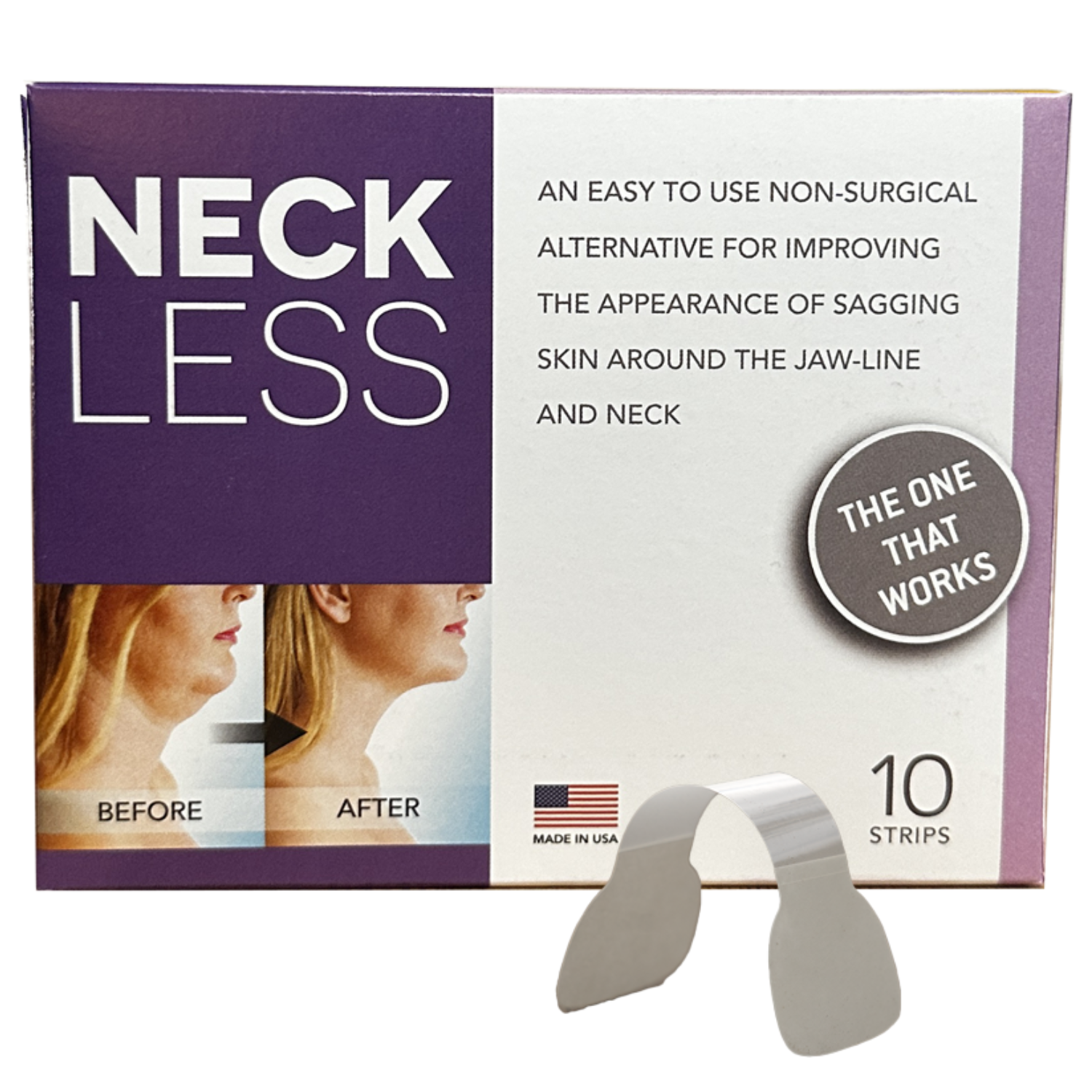
At-home devices also do not produce immediate results. If you have an event this weekend and want a visibly tighter neck by Saturday morning, a device is not the right tool for that situation. A medical-grade lifting strip handles that need immediately, while the device works on the longer-term structural picture simultaneously. The two approaches are genuinely complementary. Here is how lifting strips work for turkey neck if you want to understand that side of the equation.
How to Get the Most Out of an At-Home Device
Consistency is the single most important variable. A device used five times in its first week and then left on the bathroom shelf will not produce results. A device used three times per week for twelve weeks almost certainly will, assuming the technology is appropriate for the concern.
Start with clean, dry skin. Apply a conductive gel or serum if the device requires it. Move the treatment head upward along the neck toward the jawline, working in sections. Keep each pass slow and deliberate rather than rushing through the treatment area. Follow the manufacturer's protocol for session duration and frequency rather than assuming more is better — at-home devices are designed with specific parameters for safety and effectiveness.
Pair device use with a supporting skincare routine. Vitamin C in the morning, peptide-rich moisturizer twice daily, and SPF on the neck every day without exception create the skin quality foundation that device treatment builds on. A complete neck care routine guide covers how to build that foundation alongside any device protocol you choose.
Track results with consistent photos taken in the same lighting, from the same angle, at the same time of day. The changes that devices produce are gradual enough that they are easy to miss day to day but clearly visible when you compare week one to week twelve. Without photos, most women underestimate the results they are getting.
Where Devices Fit in the Full Non-Surgical Picture
At-home devices occupy a specific position in the range of non-surgical neck tightening options. They produce cumulative results that build over months, cost significantly less than clinical treatments, and require no appointment or recovery time. They are slower and less powerful than clinical RF or Ultherapy, but for women who use them consistently they can produce a result that genuinely changes the appearance of the neck over a season of use.
For a complete comparison of every non-surgical option available including energy-based clinical treatments, injectables, topicals, and lifting strips ranked by timeline, cost, and realistic outcome, this guide to non-surgical neck tightening options covers the full landscape. And if you want to understand how at-home contouring approaches fit alongside devices, the neck contouring without surgery guide maps all of the approaches together.
The women who get the best results from at-home devices are almost always the ones using them as part of a layered approach: a daily lifting strip for immediate results, a consistent skincare routine for skin quality, and a device protocol running in the background for cumulative structural improvement. None of the three replaces the others. Together they address the neck from every angle simultaneously.
The Bottom Line
The best at-home neck tightening device in 2026 is one that uses RF, microcurrent, or a combination of both, has a treatment head appropriate for the neck's surface area, and most importantly, one you will actually use consistently for three months. The technology works. The results are real. But they belong to the women who show up for them consistently, not the ones who try for two weeks and declare the category a disappointment.
If you are not yet sure whether a device is the right starting point for your concern or whether another approach makes more sense first, reading what women with similar concerns have experienced is a useful place to begin.
Want results while your device does its long-term work? Shop Neck Less lifting strips in 10, 25, 50, or 100-pack options. Patented. Made in the USA. 30-day money-back guarantee.
Hope Granger is a beauty and wellness writer who has spent over a decade covering non-surgical skincare, aging gracefully, and women's confidence. She writes for women who are done being sold false promises and just want honest answers.