
The Best Non-Surgical Neck Tightening Options You Can Use at Home
If you've started looking into how to tighten your neck without surgery, you've probably already realized something frustrating. Most of the credible options involve booking an appointment somewhere. Radiofrequency. Microneedling. Ultherapy. They work, but they require time, money, and a willingness to sit in a clinical chair while a stranger holds a device against your skin. For a lot of women, that's a non-starter.
The at-home category is supposed to be the answer to this. And to be fair, parts of it are. But it's also where the most marketing nonsense lives — gadgets that promise miracles, creams with mystery ingredients, and TikTok-fueled fads that delete themselves from your routine three weeks in.
So here's the honest version. What actually works for at-home neck tightening, what's overhyped, and what to skip entirely. If you've already read my broader breakdown of seven non-surgical options, this one zooms in on the at-home category specifically — the tools and routines you can use without leaving your house or making a single phone call.
What "At-Home Neck Tightening" Actually Means
Before we get into the ranking, it helps to clarify what we're talking about. At-home neck tightening covers any approach you can use yourself, on your own schedule, without a professional. That includes topicals (creams, serums, retinoids), tools (LED masks, microcurrent devices, gua sha), strips and tapes, and routine-based approaches like exercises and consistent SPF.
The category does not include radiofrequency or ultrasound treatments — those require specialized equipment and trained operators. And it does not include the various "DIY tightening" recipes circulating on social media (egg whites, tape from the hardware store, you've seen them), most of which are either useless or genuinely harmful to your skin.
What makes a real at-home option real: it's evidence-backed, safe for daily use on neck skin, and doesn't require you to compromise your skin barrier or your dignity to use it.
1. Daily SPF on the Neck
Cost: Whatever you already spend on sunscreen | Effort: 3 extra seconds | Effectiveness: ★★★★★
I know. SPF first, again. But the reason it keeps coming up in every article is that it genuinely is the most important thing you can do for your neck. UV exposure accounts for approximately 80% of visible facial and neck aging according to research in the Journal of Investigative Dermatology. Not genetics. Not time. Sun.
If your sunscreen routine stops at the jawline — and for most women it does — you're protecting roughly half the area that ages most visibly. Extending it down to the neck and chest takes seconds and costs nothing extra. It won't reverse what's already happened, but it stops adding to the problem starting today. Few interventions in skincare offer this kind of return for this little effort.
2. Medical-Grade Lifting Strips
Cost: $30–$110 per box | Effort: 30 seconds in the morning | Effectiveness: ★★★★★ (immediate)
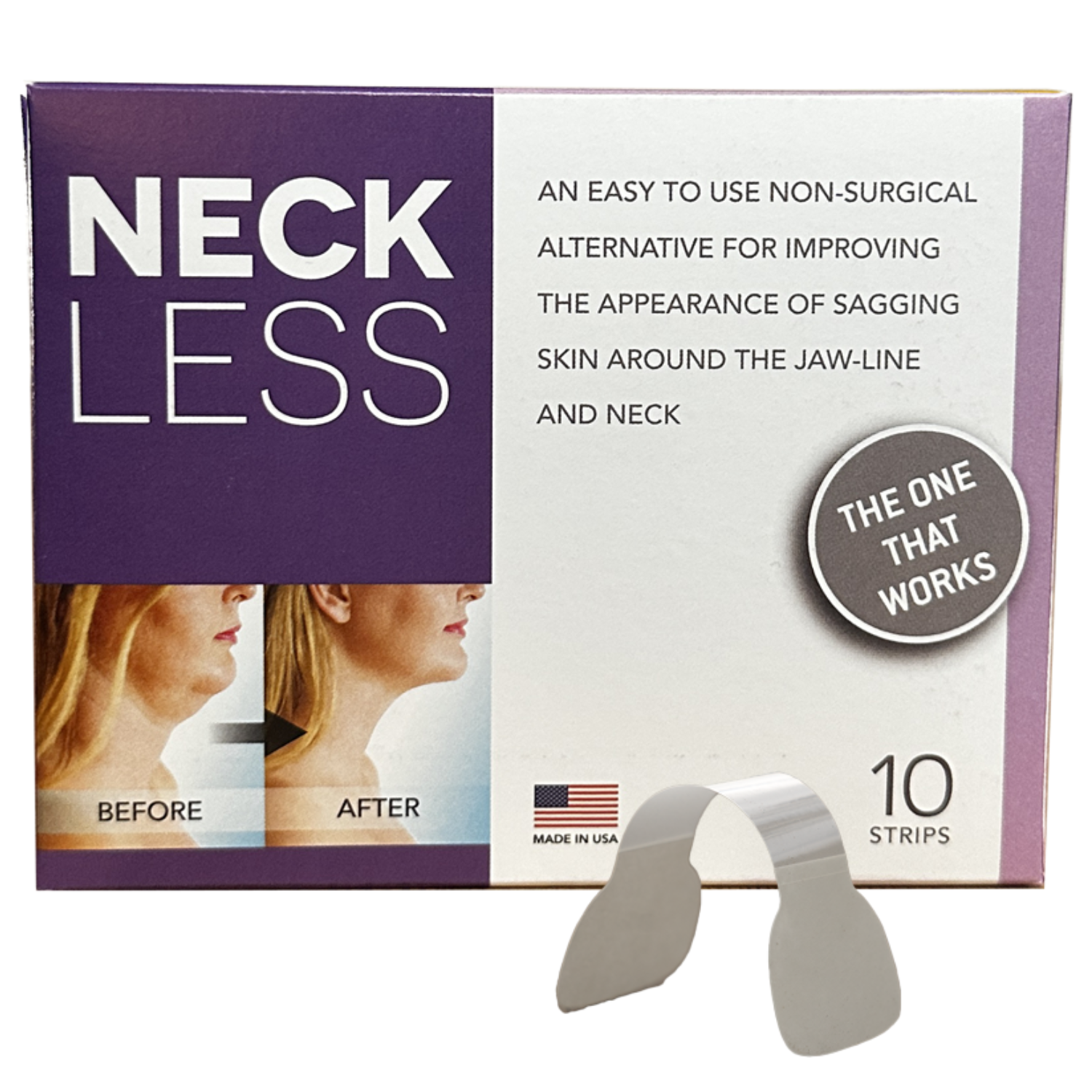
This is the at-home category that surprised me most when I first started writing about it. Neck Less is a patented, medical-grade strip developed by aestheticians for turkey neck and sagging neck skin. You apply it in seconds — it sits beneath your hair, invisible — and it physically lifts and smooths the neck area for up to 10 hours.
The reason it ranks this high is that nothing else in the at-home category produces visible results the same morning. Creams need eight to twelve weeks to do anything measurable. Devices need months of consistent use. Lifting strips show you the result in the bathroom mirror before you've finished your coffee.
The honest caveats: it's a same-day solution, not a permanent change. You're physically supporting the skin while you wear it, not restructuring the underlying tissue. But for women who want a visible lift for work, photos, events, or just a day they want to feel like themselves, this is the most direct path I've found. Most neck tapes on the market are overseas knockoffs that don't hold past lunch — Neck Less is the only patented, made-in-the-USA option I've seen.
3. Retinoids for the Neck
Cost: $30–$150 | Effort: Nightly application | Effectiveness: ★★★★ (over 8–12 weeks)
Retinoids are probably the most evidence-backed topical for skin structure. They speed up cellular turnover and signal the skin to produce more collagen. Multiple peer-reviewed studies have shown measurable improvements in skin firmness with consistent use over months.
The catch is the timeline. You won't see anything for the first few weeks, you might see a little dryness or flaking around week three, and meaningful improvement typically shows up around the eight-to-twelve-week mark. This is not a fast solution.
The other catch is that neck skin is more sensitive than face skin, so you generally want to start with a lower concentration than what you'd use on your face. Apply at night, follow with moisturizer, and be patient. Layer SPF over it during the day because retinoids increase sun sensitivity, which would defeat the entire purpose if you skipped this step.
4. Peptide Serums
Cost: $25–$120 | Effort: Daily application | Effectiveness: ★★★ (gradual support)
Peptides are short chains of amino acids that signal skin cells to behave in certain ways — depending on the peptide, that might be increasing collagen production, improving elasticity, or supporting hydration. They're a quieter, gentler alternative to retinoids.
They work, but more modestly. Think of peptides as supportive infrastructure rather than the main event. They pair well with retinoids in a complete routine — retinoid at night, peptide-rich serum in the morning — but on their own, they're not going to drive dramatic visible change.
What I'd avoid: any peptide product that promises "instant lifting" or "wrinkle erasing in seconds." That's marketing language, not skincare science.
5. Vitamin C Serum
Cost: $20–$100 | Effort: Daily application | Effectiveness: ★★★ (over time)
Vitamin C is one of the most studied antioxidants in skincare. It helps neutralize free radicals from UV and pollution, supports collagen synthesis, and brightens uneven tone over time. For the neck specifically, it's particularly useful because the neck typically gets more cumulative sun damage than the face, so antioxidant support has more work to do here.
The biggest practical thing to know about vitamin C is stability. L-ascorbic acid (the most active form) degrades quickly when exposed to light and air, which is why it's often packaged in opaque or amber bottles. If your vitamin C serum has turned brown, it's no longer doing what it was supposed to do — replace it.
Apply in the morning, follow with SPF, and treat it as a long-term investment in your skin's resilience rather than a quick fix.
6. Microcurrent Devices
Cost: $200–$500+ | Effort: 5–10 minutes daily | Effectiveness: ★★★ for muscle tone
Microcurrent devices like NuFACE deliver low-level electrical currents that contract facial and neck muscles, with the goal of toning and lifting the underlying musculature over time. There's some evidence that consistent use produces measurable improvement in muscle tone, particularly for the platysma muscle that runs from the chest to the jawline.
The key word is consistent. These devices only work if you use them five times a week or more, for months at a time. If you're not the type to maintain a daily skincare device routine, the return on a $400 purchase is going to be disappointing.
What microcurrent does well: muscle tone. What it doesn't do: tighten skin that has lost elasticity. If your concern is more about loose skin than weak underlying muscle, this is probably not the right tool — and that distinction matters more than most marketing acknowledges.
7. LED Light Therapy
Cost: $100–$500 | Effort: 10–15 minutes, 3–5x weekly | Effectiveness: ★★★ (gradual)
LED masks and panels use specific wavelengths of light — typically red and near-infrared — to stimulate cellular processes that support collagen production. Clinical research has shown modest but real improvements in skin firmness with consistent LED use.
The "consistent" qualifier matters here too. LED is a slow accumulator. You're not going to see dramatic change in two weeks. You're investing in a months-long process that supports your skin's regenerative capacity from the inside.
If you're already someone who builds skincare devices into your routine, an LED mask is a reasonable addition. If you're not, the device will likely end up in a drawer.
8. Neck Exercises
Cost: Free | Effort: 5 minutes daily | Effectiveness: ★★ for muscle tone, not skin
Chin tucks, platysma stretches, jaw clenching exercises — they're all over YouTube and TikTok, and they're worth doing if you have a few minutes. The platysma muscle responds to consistent training the same way any muscle does, and over time you can develop better tone there.
The honest limit: exercises strengthen the muscle underneath the skin. They don't tighten skin that has already lost elasticity. If your concern is primarily structural skin laxity, exercises will produce minimal visible improvement no matter how diligent you are.
Still worth doing because they're free and they support overall neck health. Just don't expect them to do the main job alone.
What to Skip
A few things that get heavily marketed in this category that I'd avoid:
Generic "neck firming" creams. Most of these are moisturizers with marketing copy. They hydrate, which makes skin temporarily look slightly better, but they don't tighten anything in any meaningful way. If your concern is sagging, a $60 firming cream is not going to deliver. A real medical-grade approach is a different category of product.
DIY tightening masks. Egg whites, gelatin, and other "natural tightening" home remedies do produce a temporary tight feeling because they shrink as they dry. That sensation is your skin being pulled by a drying film, not actually tightening. The effect lasts about as long as the mask is on your face.
Tape from the hardware store. Yes, this is a thing people do. No, it does not work and yes, it can damage your skin badly. Industrial adhesives are not formulated for skin. Use products designed for skin contact.
Anything claiming "facial yoga reverses sagging." Some facial movement is fine, but the influencer claims about reversing collagen loss through specific movements aren't supported by evidence. Move your face normally. Don't make it a project.
Building an At-Home Routine That Actually Works
Here's the framework I'd suggest if you're starting from scratch.
Foundation (every day, no exceptions): SPF on your neck, applied at the same time you do your face. This is non-negotiable if you want any of the other things to matter.
Long-term work (consistent over months): A retinoid at night, extended down to the neck. A vitamin C serum in the morning under SPF. Optionally a peptide-rich moisturizer if your skin tolerates the stack.
Same-day visible results: Medical-grade lifting strips for the days you want immediate impact. Use them as part of your morning routine the way you'd use SPF or moisturizer. Application takes under 30 seconds once you've done it a few times.
Optional add-ons: Microcurrent or LED if you're someone who reliably uses skincare devices. Skip both if you know yourself and that's not you.
That's it. Five things. Three of which are basically passive (SPF, retinoid, vitamin C take seconds) and one of which gives you a result you can see immediately. The whole routine takes under five minutes a day once you've built the habit.
The Bottom Line
The best at-home neck tightening doesn't come from a single miracle product. It comes from stacking a few simple things that each address a different layer of the problem. SPF prevents further damage. Retinoids and vitamin C support collagen over time. Lifting strips deliver the visible result you want today.
What doesn't work is chasing the latest TikTok device or the firming cream that promised dramatic results in two weeks. The honest path is also the boring one — small, consistent habits, applied to the part of your body that most skincare routines have ignored your entire life.
Once you start treating your neck like it deserves the same care as your face, the results take care of themselves.
Ready to add immediate results to your at-home routine? Shop Neck Less lifting strips in 10, 25, 50, or 100-pack options. Patented. Made in the USA. 30-day money-back guarantee.
Hope Granger is a beauty and wellness writer who has spent over a decade covering non-surgical skincare, aging gracefully, and women's confidence. She writes for women who are done being sold false promises and just want honest answers.