

Ozempic Neck Is Real: What Rapid Weight Loss Does to Your Neck (and What Actually Helps)
Ozempic neck is real, but the name is a little misleading.
The loose skin, crepey texture, deeper lines, and loss of definition some people notice around the neck and jawline after taking Ozempic are not a unique disease caused by Ozempic itself. "Ozempic neck" is an informal name for a very familiar problem: neck skin laxity after significant or rapid weight loss. It can happen after weight loss with Ozempic, Wegovy, Zepbound, Mounjaro, bariatric surgery, or simply losing a substantial amount of weight through diet and exercise.
What has changed is how many people are losing meaningful amounts of weight, and how quickly. In the landmark semaglutide weight-management trial, participants receiving semaglutide 2.4 mg lost an average of 14.9 percent of their body weight over 68 weeks. When the volume beneath the skin changes that substantially, the face and neck can look different too.
The neck is one of the places where those changes can be especially noticeable.
This guide explains what Ozempic neck actually is, why rapid weight loss can make your neck look older, whether the skin can tighten on its own, and which options actually help, from skincare and physical lifting support to professional treatments and surgery.
What Is Ozempic Neck?
"Ozempic neck" describes loose, wrinkled, or sagging skin around the neck and beneath the jaw after substantial weight loss.
You may notice:
- Loose skin underneath the chin
- A softer or less defined jawline
- Vertical folds or bands in the neck
- More visible horizontal neck lines
- Crepey or finely wrinkled skin
- Skin that appears to hang where there was previously more volume
- A more prominent "turkey neck" appearance
The term has become associated with Ozempic because semaglutide and other GLP-1-based medications have made substantial weight loss achievable for a much larger group of people. But the underlying phenomenon existed long before these medications.
Research on people after major weight loss has documented both loss of facial volume and increased skin laxity, including significant changes in the central neck. Studies of skin after massive weight loss have also found changes in collagen organization and the supporting structure of the dermis.
So yes, the appearance people are calling Ozempic neck is real.
But it is more accurately described as weight-loss-related neck laxity.
Why Does Rapid Weight Loss Affect the Neck?
Think about what happens to an inflated balloon after some of the air is released.
The outside does not automatically shrink in perfect proportion to what was removed from inside.
Skin is far more complex than a balloon, of course, but the same basic issue exists. When you carry more weight, the skin and connective tissues expand around the volume underneath them. When a significant amount of that volume disappears, there is suddenly more skin relative to the tissue it needs to cover.
How well that skin retracts depends on several things.
You Lose Fat Beneath the Skin
Weight loss does not occur only around the stomach, hips, or thighs.
Fat is also lost from the face, beneath the chin, along the jawline, and around the neck.
That facial fat may not have been something you thought of as beneficial when it was there, but it provided volume beneath the skin. Once some of that volume disappears, previously supported skin can become noticeably looser.
This is essentially the same reason people talk about "Ozempic face."
The difference is that the neck already has several disadvantages.
Neck Skin Is Already Thin and Vulnerable
The neck has thinner skin, fewer oil glands, and less structural support than many areas of the face. It is also constantly moving, exposed to sunlight, and frequently neglected during skincare and sunscreen application.
That is why the neck often shows aging earlier than the face in the first place.
If you want the full explanation, our guide to why the neck ages faster than the face breaks down the anatomy in more detail.
Add major weight loss to skin that was already becoming thinner and less resilient with age, and the change can suddenly become much more visible.
Skin Elasticity Declines With Age
Younger skin generally has a better ability to accommodate changes in body size.
As collagen, elastin, underlying fat, and other supporting structures change with age, the skin becomes less capable of returning to its previous position after it has been stretched.
That means two people can lose exactly the same amount of weight and have completely different results around the neck.
Your age matters. Genetics matter. How long you carried the additional weight matters. Sun exposure matters. The amount of weight you lose matters.
And the condition of your skin before the weight loss matters.
Rapid Weight Loss Makes the Change More Obvious
The faster your appearance changes, the more dramatic the contrast can seem.
That does not mean someone should change the dose of a prescription medication or deliberately interfere with medically appropriate weight loss to protect the appearance of their neck. Those decisions belong between you and the clinician prescribing your medication.
It does mean that losing a large amount of facial and neck volume can reveal skin laxity that was previously hidden.
Is Ozempic Actually Damaging Your Neck Skin?
This is where a lot of online explanations go too far.
There is not good evidence that Ozempic selectively attacks the skin of the neck or creates a unique condition there.
The stronger evidence points to the effects of substantial weight and volume loss.
The same type of loose skin has been documented for decades after bariatric surgery and other forms of major weight loss. Research examining patients after massive weight loss describes deflation of facial tissues, loss of skin elasticity, and increased laxity in the face and neck.
In other words, Ozempic can be part of the chain of events:
Medication → substantial weight loss → loss of facial and neck volume → previously stretched or less-elastic skin becomes more visible.
That distinction matters.
Your successful weight loss did not suddenly "ruin" your neck. It changed what is underneath the skin, and now you are seeing the skin itself more clearly.
Who Is Most Likely to Get Ozempic Neck?
There is no formula that can predict exactly how your neck will respond to weight loss.
But noticeable loose neck skin is more likely when several factors overlap:
Larger total weight loss. The more volume that disappears, the more skin has to accommodate the new contour.
Older age. Skin generally becomes thinner and less elastic over time.
Long-term excess weight. Skin that has remained stretched for many years may not retract as completely.
Existing turkey neck or jawline laxity. Weight loss can reveal an issue that was already developing beneath greater facial volume.
Significant sun exposure. UV damage contributes to collagen breakdown and reduced skin quality.
Genetics. Some people simply maintain better skin elasticity than others.
This is also why someone can lose 50 pounds and have very little loose neck skin while another person notices significant changes after losing considerably less.
Will Ozempic Neck Go Away?
Sometimes it improves.
That is different from saying it will completely disappear.
After weight stabilizes, your appearance may continue to change as your tissues adjust to your new body composition. Mild laxity can look less dramatic over time, particularly in younger people with good skin elasticity.
But genuinely excess skin does not always shrink enough to fit a substantially smaller underlying structure.
The more significant the laxity, the more important realistic expectations become.
If you have a small amount of crepey skin, improving hydration, skin quality, collagen support, and sun protection may make the area look noticeably better.
If you have several centimeters of hanging excess skin, no cream is going to make that skin disappear.
That is the line marketing rarely tells you.
What Actually Helps Ozempic Neck?
The right answer depends on what you mean by "helps."
Some options improve the quality of the skin.
Some create temporary visible tightening or lifting.
Some encourage a modest degree of tissue tightening over time.
And one category can actually remove significant excess skin.
Those are very different outcomes.
1. Start With a Real Neck Skincare Routine
Skincare cannot remove excess skin after major weight loss.
It can, however, improve hydration, texture, fine lines, pigmentation, and the overall quality of the skin you have.
That makes it worthwhile.
For most people, the essentials are:
Morning: vitamin C or peptides, moisturizer, and SPF 30 or higher.
Evening: a retinoid if tolerated, followed by a barrier-supporting moisturizer.
If you are starting from scratch, our complete neck skin care routine explains the ingredients to consider, how to use them, and the right order for your morning and evening routine.
And do not skip sunscreen.
There is little point investing in collagen-supporting ingredients while exposing the same skin to UV damage every day.
2. Protect Muscle While Losing Weight
Weight loss includes changes in both fat mass and lean mass, although the proportions vary considerably between people and treatments.
Maintaining adequate nutrition and incorporating resistance exercise when medically appropriate can help support overall muscle and body composition during weight loss.
Will building muscle "fill out" loose neck skin?
No.
That claim gets repeated online, but resistance training cannot replace lost facial fat or eliminate excess neck skin.
It is still an important part of maintaining strength and healthy body composition during significant weight loss. Talk with your physician or a registered dietitian about protein and nutrition needs, particularly if a GLP-1 medication has significantly reduced your appetite.
3. Use Physical Lifting Support When You Want an Immediate Difference
This is where skincare and physical support solve two completely different problems.
A retinoid works over months.
A moisturizer improves surface hydration.
A procedure may stimulate collagen over several months.
But sometimes you want your neck and jawline to look better today.
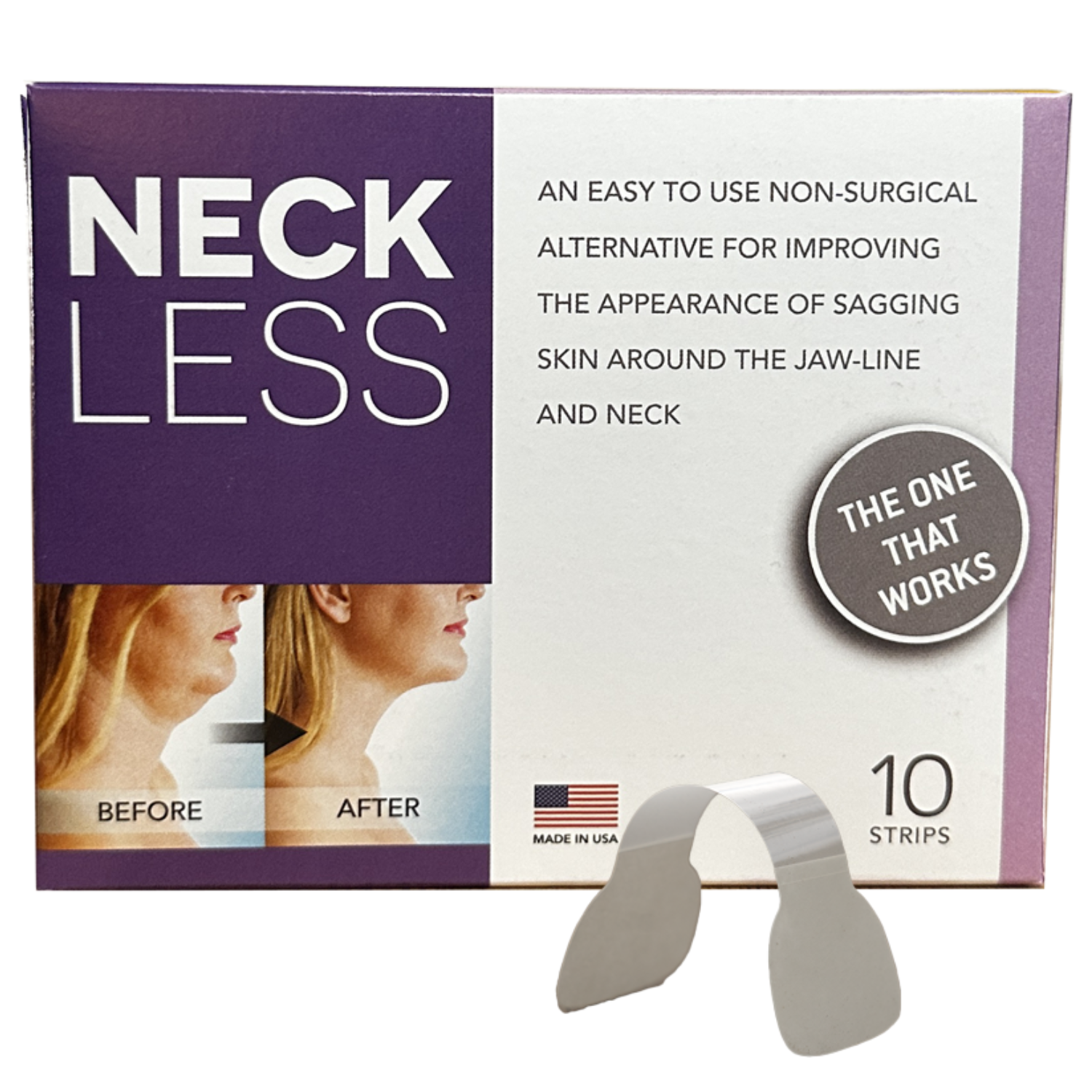
Neck Less lifting strips physically reposition loose skin to create a smoother, more defined appearance while they are being worn. They do not claim to rebuild collagen or permanently eliminate loose skin. They provide mechanical support.
That distinction is exactly why they can be useful for Ozempic neck.
When the primary problem is that there is simply more skin than your new neck contour needs, physically repositioning that skin can create an immediate cosmetic improvement that a topical product cannot.
For someone who wants to see whether the approach works before purchasing a larger supply, the 10-strip Neck Less pack is an easy place to start.
4. Consider Professional Skin-Tightening Treatments for Mild to Moderate Laxity
There is an enormous market for devices promising to tighten loose skin.
Some have legitimate evidence behind them.
None should be confused with surgery.
Dermatologists and cosmetic providers use treatments including radiofrequency, ultrasound, and certain laser procedures to heat tissue beneath or within the skin and encourage collagen remodeling. Results develop gradually and tend to be most appropriate for people who have some laxity but do not have a large amount of hanging excess skin.
Options may include:
- Radiofrequency skin tightening
- Radiofrequency microneedling
- Microfocused ultrasound
- Laser resurfacing
- Combination treatments
The specific technology matters less than whether you are actually a good candidate.
If most of what you are seeing is texture and mild laxity, these approaches may be reasonable.
If you can physically pinch and lift a substantial fold of excess skin, expectations should be much lower.
Our guide to the best at-home neck tightening devices covers what home technology can realistically do before you spend money on a device.
5. Understand When Surgery Is the Only Way to Remove the Skin
This is the answer nobody selling a cream or gadget wants to give you.
If significant excess skin is the problem, the only way to actually remove that skin is to remove it.
A neck lift can address loose skin, reposition deeper tissues, improve the contour beneath the chin, and redefine the jawline.
That does not mean everyone with Ozempic neck needs surgery.
Far from it.
It means there is a biological limit to what collagen stimulation, moisturizers, exercise, and non-invasive devices can accomplish. Knowing that before spending thousands of dollars chasing a surgical-level result from non-surgical treatments is useful.
For the broader range of options, our guide to how to contour your neck without surgery explains what different non-surgical approaches can and cannot realistically accomplish.
What Does Not Fix Ozempic Neck?
The explosion of interest in GLP-1 medications has created an equally large market for products claiming to fix the cosmetic changes associated with them.
Be skeptical.
Creams That Promise to "Melt" Turkey Neck
A topical product cannot remove a large fold of excess skin.
Good skincare can improve skin quality. That is worthwhile.
It cannot make inches of skin disappear.
Losing Even More Weight
If the issue is loose skin rather than remaining submental fat, additional weight loss may make the laxity more noticeable, not less.
Do not make medication or weight-management decisions based on the appearance of your neck. Discuss your health goals and treatment with the clinician managing your care.
Random Supplements Marketed Specifically for Ozempic Skin
There is no supplement that selectively tightens loose neck skin created by substantial weight loss.
Adequate nutrition matters. Meeting your protein, vitamin, mineral, and hydration needs matters.
That is different from a bottle promising to erase Ozempic neck.
Expecting Retinol to Perform a Neck Lift
Retinoids are among the best-supported ingredients in anti-aging skincare.
Use one if your skin tolerates it.
Just understand what you are asking it to do. Improving collagen production and skin texture is not the same thing as mechanically repositioning or removing excess skin.
Ozempic Neck vs. Turkey Neck: Is There a Difference?
Mostly, the cause.
Turkey neck is the general term for loose, sagging skin beneath the chin and around the neck. It commonly develops as a result of aging, genetics, sun damage, changing fat distribution, and loss of structural support.
Ozempic neck describes a similar appearance that becomes noticeable during or after substantial weight loss associated with Ozempic or another weight-loss medication.
Once the laxity exists, many of the treatment considerations are the same.
If you want to understand what is happening beneath the surface, the science behind turkey neck explains how skin, fat, muscle, collagen, and gravity all contribute.
Can You Prevent Ozempic Neck?
There is no guaranteed way to prevent loose skin during major weight loss.
And preventing cosmetic neck changes should never take priority over medically appropriate treatment for obesity, diabetes, cardiovascular risk, or another condition for which your medication was prescribed.
What you can control is the environment you give your skin and body during the process.
- Protect your neck from UV exposure.
- Use a consistent neck skincare routine.
- Stay adequately nourished.
- Include resistance exercise if your medical team says it is appropriate.
- Avoid smoking.
- Discuss significant changes in weight, appetite, nutrition, or muscle strength with the clinician managing your medication.
What you should not do is change or stop a prescription medication because you are worried about your neck without first talking to your prescriber.
Frequently Asked Questions About Ozempic Neck
Does Ozempic Cause Turkey Neck?
Ozempic is not known to cause a unique neck disorder called turkey neck. The term "Ozempic neck" describes loose or sagging neck skin that can become more noticeable after significant weight loss. Similar changes occur after other forms of substantial weight loss.
Does Ozempic Neck Go Away After You Stop Ozempic?
Stopping Ozempic does not automatically tighten loose skin, and prescription medication should never be stopped solely for cosmetic reasons without discussing it with your healthcare provider. Some mild laxity may become less noticeable after weight stabilizes, but significant excess skin may remain.
How Do You Tighten Loose Neck Skin After Weight Loss?
The options depend on severity. Skincare can improve texture and skin quality. Physical lifting strips can temporarily reposition loose skin. Professional radiofrequency, ultrasound, and laser treatments may provide modest tightening in appropriate candidates. Significant excess skin generally requires surgery for complete removal.
Does Retinol Help Ozempic Neck?
Retinoids can improve signs of skin aging and support collagen remodeling over time, but retinol cannot remove substantial excess skin. Think of it as improving the skin itself rather than changing how much skin you have. Our neck skin care routine guide explains how to introduce retinoids and other active ingredients to the thinner skin of the neck.
Can You Get Ozempic Neck From Wegovy, Zepbound, or Mounjaro?
The appearance is not specific to one brand. Loose neck skin can become visible after significant weight loss from semaglutide, tirzepatide, bariatric surgery, diet and exercise, or other causes. "Ozempic neck" has simply become the popular name for the phenomenon.
What Is the Fastest Way to Improve the Appearance of Ozempic Neck?
If you mean an immediate cosmetic change, physically repositioning loose skin with a lifting strip works on a completely different timeline from skincare or collagen-stimulating procedures. Skincare and professional treatments require time, while surgical procedures involve recovery.
Neck Less lifting strips provide an immediate physical approach by repositioning loose neck skin while the strip is being worn. The right long-term strategy depends on whether you want temporary appearance improvement, gradual skin-quality improvement, or permanent removal of excess skin.
The Bottom Line on Ozempic Neck
Ozempic neck is real.
But it is not evidence that Ozempic has somehow damaged your neck.
It is usually the visible result of something much simpler: your body became smaller faster or more substantially than the skin around your neck was able to contract.
That can be particularly noticeable after significant weight loss because the neck already has thin skin, limited structural support, constant movement, and years of accumulated sun exposure working against it.
Start with realistic expectations.
Protect and improve the skin you have. Maintain your health and muscle while losing weight. Give your body time after your weight stabilizes. Consider professional tightening treatments if your laxity is mild enough for them to make a meaningful difference. And understand that substantial excess skin cannot be permanently erased by a cream.
On the days when you simply want the skin lifted now, physical support fills a gap that skincare cannot.
Weight loss changed your body. It does not have to determine how you feel about your neckline. Shop Neck Less lifting strips in 10, 25, 50, or 100-pack options. Patented. Made in the USA. 30-day money-back guarantee.